
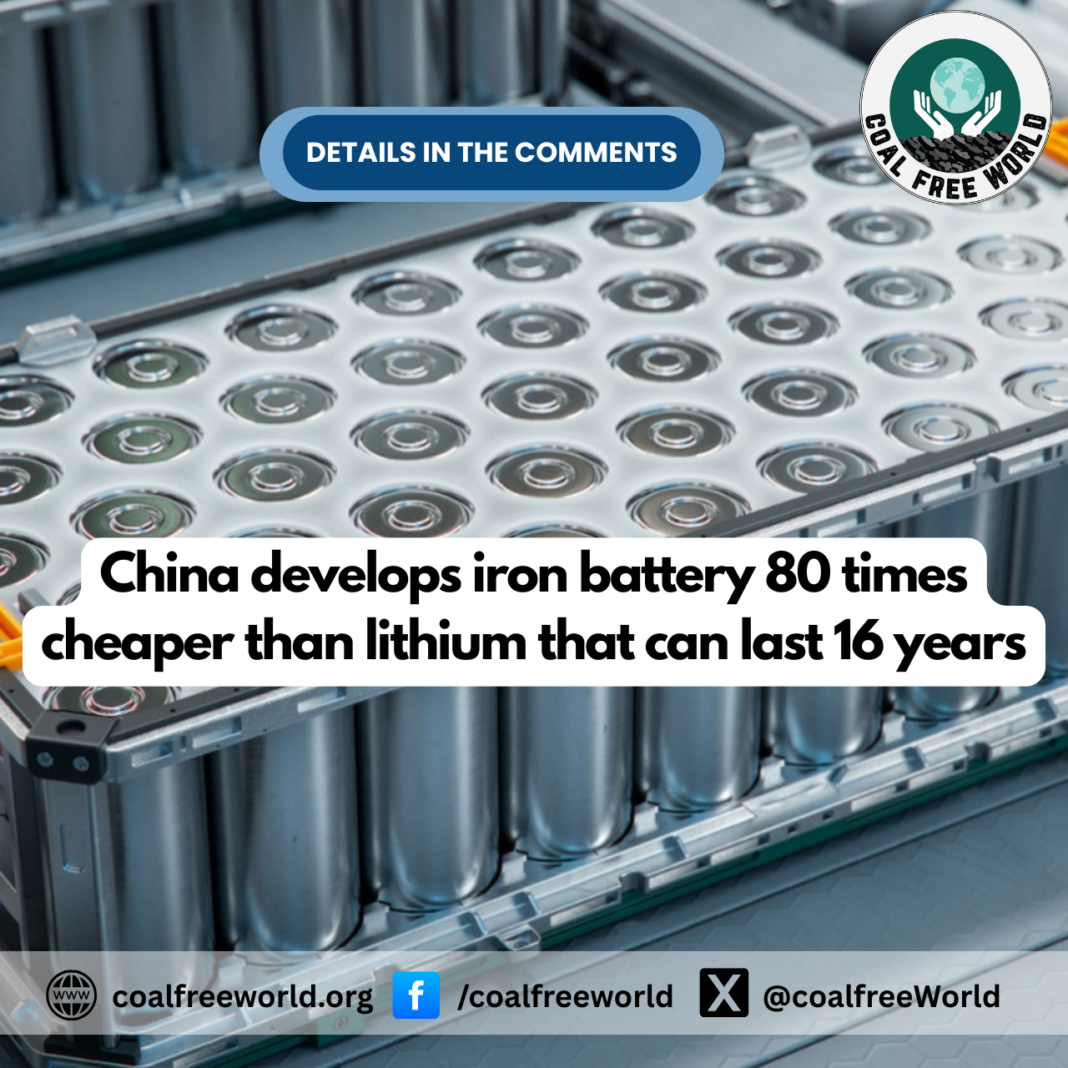

A research team at the Institute of Metal Research of the Chinese Academy of Sciences (CAS) has advanced “all-iron” flow battery technology.
In particular, a newly formulated electrolyte facilitates thousands of charge-discharge cycles. It provides a budget-friendly, high-endurance answer for the world’s massive energy storage needs.
The development solves the long-standing issues of material degradation and leakage (crossover) by re-engineering the iron complex at the molecular level.
Cheaper alternative
The high price disparity between raw materials is a main driver of this innovation, with lithium currently trading at over 80 times the cost of iron. The massive price gap makes iron-based batteries a viable alternative to overcome the supply constraints that are stalling the global shift to green energy.
Experts hope that replacing expensive, supply-constrained lithium with earth-abundant iron will finally make grid-scale renewable energy storage financially viable, offering a cheap, scalable method to stabilize power supplies when solar and wind energy are unavailable.
All-iron flow batteries hold immense potential due to their use of cheap, abundant iron and safe, water-based electrolytes. However, the path to the market has been blocked by technical instability on the battery’s negative side.
In these systems, the active materials tend to degrade and leak through the membrane, a process that rapidly wears out the battery and limits its practical lifespan.
To overcome existing hurdles, the Chinese team employed a “synergistic design” at the molecular level, engineering a specialized iron complex that serves as a double-layered defense.
The South China Morning Post stated that this molecule uses its rigid, bulky structure to physically shield the iron core from chemical attack, while its strong negative charge creates a force field that repels leaking particles.
Together, these mechanisms prevent the battery’s active materials from degrading or from escaping across the membrane, thereby ensuring long-term stability.
Sixteen years, zero decay
The battery prototype demonstrated endurance, maintaining a stable structure and perfect reversibility over 6,000 cycles — equivalent to more than 16 years of daily operation — with zero loss in storage capacity.
Throughout this period, the system remained free of harmful by-products or sediment while achieving a 99.4 percent leak-proof efficiency. Even at high power outputs, it retained 78.5 percent of its energy efficiency, proving that the design is both reliable and durable.
Reportedly, this new design also outperformed conventional systems by reducing active material leakage.
The development arrives as the international race to develop iron-based flow batteries accelerates, with the technology increasingly viewed as the most viable successor to lithium-ion for large-scale grid storage.
In the United States, companies like Oregon-based ESS Tech Inc. are already deploying iron flow systems for tech giants like Google.
However, some of these existing designs could struggle with “dendrites” — tiny, needle-like crystals that can short-circuit the battery. The Chinese team believes they have leapfrogged these hurdles by using an alkaline-based chemistry and their new molecular “shield.”
This extended lifespan is a game-changer for grid-scale storage, as it cuts long-term costs and ensures the reliable, decades-long operation required to make renewable energy affordable.